why a high boost reading in a supercharged engine may be indicative of an engine cylinder head problem p. 9-71
why the boost reading in a supercharged engine is indicative of the fuel split between hat & port nozzle and recommended fuel split ratios
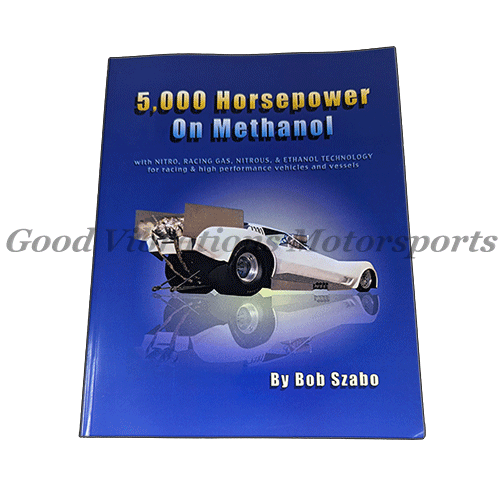
Big Power From Science & Tuning That Money Cannot Buy
chemical dissociation before & during combustion affects power & backfiring
effect of methanol enrichment on power making
table of methanol engine compression ratios p. 9-69
analysis of a 500 ci, 9,500+ HP engine on methanol p 15-132
putting methanol into a racer with the fuel tank in the rear p. 6-51
table of racing fuel weights p. 10-78
various normally asp. & supercharged dyno power levels
Nitro & Methanol
air to fuel ratios of nitro / methanol mixtures
nitro temperature info
nitro fuel weight
brake specific fuel consumption
Nitrous Oxide
nitrous & methanol
nitrous & gas with methanol
Ethanol
ethanol details compared to methanol
brake specific fuel consumption
ethanol temperature info
ethanol fuel weight
Gasoline & Methanol
methanol engine dyno HP vs. gasoline engine dyno HP example p 6-49, 9-65
gasoline details compared to methanol
gasoline & methanol blends p 15-133
why methanol has half the amount of heat energy than gasoline, yet why it makes more power
how to tune for flame speed differences between methanol & gasoline
air to fuel ratios of gasoline
gasoline temperatures including vaporization & self ignition
brake specific fuel consumption p 16-149
Temperature & Methanol
how engine temperature effects methanol engine power
ideal intake manifold & engine temperatures for power
why the methanol boiling point can be better in bracket drag racing than the gasoline boiling point for consistency p 9-75
how to avoid power limits from methanol self ignition and hot plate ignition temperature effects
cooling from methanol many times that of gasoline
Methanol Octane & Racing Power
methanol octane characteristics throughout chapter 15
knock in methanol p. 15-131
Methanol Intake, Compression, Power, & Exhaust (Applicable To Other Fuels)
intake cycle throughout chapter 18, 19, & 20
compression cycle throughout chapter 21
power cycle throughout chapter 22
exhaust cycle throughout chapter 23
Current & Future
The presentation goes far beyond anything ever published for racing methanol. It is all about methods that are within current racing rules.
Info For All Power Levels:
Applies to various power levels & engine sizes from one half horsepower to 5,000 horsepower. Setups for EXTREME power levels on methanol
Information in the book is written around the 4 cycle engine. However, much of it applies to 2 cycle engines as well as rotary engines. Where the information applies to those designs is included as well.