|
Mechanical Fuel Injection:
Q: Can I use a Mechanical Fuel injection system on the street?
A: Mechanical Fuel injection is not recommended for street applications. There is no partial throttle.
Q: When I purchase an Injector Hat, will I have to set it up myself?
A: All Hat assemblies purchased from Good Vibrations are setup and calibrated per application and will include a base line setup and additional pills for the end user to fine tune with.
Q: How do I prime my Fuel Injection System?
A: You can prime your system manually by squirting High Octane gasoline into the injector hat through the butterflies or you can go with an onboard priming system that utilizes an electric pump that can be activated from inside the cockpit.
Q: My barrel valve is leaking what should I do?
A: Most leaks can be easily fixed with an O-ring kit. However, if there is damage to the barrel valve or its components then you may have to replace it depending on where the damage is located.
Q: What can I do to keep my shutoff valve from vibrating closed during a pass?
A: The over-center spring bracket is designed to keep the shutoff valve positively in the ON position until it is turned off manually.
Q: How can I figure what size injector I have?
A: The best way to figure out what injector you have is to first confirm the manufacturer. If it is an Enderle hat you can simply measure the butterfly diameter and visit our Fuel Injection tech page at the below link to view our schematic of injector hats.
http://www.goodvibesracing.com/Pertinent_Poop.htm
Q: How do I know if my fuel pump is belt or cam driven?
A: To figure out the rotation of your Enderle fuel pump, place the outlet at the 12 o'clock position and if the notch on the pump cover is at the 3 o'clock position it is Cam driven. If it is at the 9 o'clock position it is belt driven. Click link for reference:
http://goodvibesracing.com/Fuel_Pump_Tech.htm
Q: How can I tell what size fuel shutoff valve I have?
A: You can measure the diameter of the brass ring behind the arm. (3/4in = AN6) (1in = AN8)
Q: Will the Enderle Big Block Chevy front cover work on all Generation blocks?
A: Enderle Chevy front cover will only work on a Gen 4 block.
Q: How can I tell if the metering piston in my barrel valve is the correct one?
A: The square style barrel valve can have 3 possible metering pistons a Blown Alcohol piston, a Blown Gas piston and a Tunnel Ram piston. The numbers that will be stamped on the serrated shaft portion of the piston is Blown Alcohol 17; Blown Gas 12; Tunnel Ram 32. If you have a K-Style barrel valve then it becomes more difficult to determine as you have to measure a notch that has been machined into the piston. Contact us for those measurements.
Q:
Can I use an Electronic fuel pump with a Mechanical Injection system?
A: No, you have to run a Mechanical pump with a Mechanical system. The reason for this is because Mechanical systems are ran off of your RPMs and the fuel flow fluctuates with them. When you try and run an Electronic pump with them they tend to over fuel the systems at times and at other times cannot supply enough fuel.
Q:
Can I run my fuel tank in the rear of the vehicle?
A: The answer to that question is both yes and no. If you want to run only 1 fuel tank on this vehicle with a mechanical injection system the answer is No you cannot run that in the rear of the vehicle. The reason for this is due to the mechanical pumps being gravity fed and having virtually no suction power. When the vehicle launches the inertia will be pushing the fuel away from the pump and will lean it out and potentially damage the pump and possibly the motor as well which is why you will require a front mount tank.
If you are up for running 2 fuel tanks on you vehicle then the answer is yes you can run the Main cell in the rear. With this setup you will have to run a Surge Tank in the front of the vehicle with either float bowls on the side of it or a manual return out the top of the tank. This surge tank will need to be supplied with fuel from the main tank in the rear with an Electronic fuel pump with equal volume of the Mechanical pump you are using on your system. From the surge tank the mechanical pump will take over and feed the motor accordingly.
Supercharging:
Q:
How much oil do I put in my supercharger?
A: You will
want to fill it to the 7 O clock bolt hole position where the snout
mounts. Or approximately half way up the sight glass if your front cover
has that installed. The amount required is usually between 16-20oz
depending on the blower size.
Q:
What type of oil do I run in my supercharger?
A:
80-90wt Gear Oil, NON-Synthetic and NON-Detergent.
Q: How
many ft lbs do I torque my blower bolts/studs down to?
A:
If using Steel bolts the recommended torque is 15-18lbs. When using the
aluminum break away studs the recommended torque is 10-12lbs. *Keep in
mind sometimes you may have to torque the rear Bolts/Studs down a little
bit more than the front to prevent the rear of the blower from lifting*
Q:
Is the Percent of Over/Under drive the same as the Boost my blower is
creating?
A: No, that is not always the case. Sometime
that can happen; however, the drive of the blower is how fast you are
spinning it in relation to the crank shaft. The boost is the amount of
PSI the blower is forcing into the motor at that given drive ratio.
Q:
Can I run a full Teflon Stripped blower on the Street?
A:
No, we strongly recommend against running this type of blower on the
street as most of the time the clearance is setup for Alcohol and it
will build a lot more Heat in the motor due to those Strips.
Q:
Do I
need to run a crank hub or a Harmonic Balancer with a Blower?
A: That is a personal preference either for you or your engine
builder. We recommend a crank hub to eliminate the excess weight of a
balancer on the end of your crankshaft. Also when running a crank hub
all accessory pulleys along with the blower pulley centers itself
properly and bolts on using the 6 bolt pattern in the hub. If you are
afraid of harmonics coming into play when running a crank hub, do not.
The belt and pulleys act as an extremely large balancer and absorb the
harmonics of the motor.
Q:
What
makes my blower surge?
A: This is caused by a
Rich/Lean cycle at idle. As the motor leans out the RPMs increase and
richens up the motor, when the motor richens up the RPMs decrease and
the motor leans out. This continual cycle is known as Blower Surge. With
proper tuning most of the surging can be eliminated.
Q:
How
tight should I run my belt?
A: Blower belt adjustment
is usually done when the motor is cold and should have 3/4" deflection
in or out on the long side of the belt. This will give you 1 1/2" total
deflection. Once the motor is warmed up this will decrease substantially
to 1/4" deflection or a total of 1/2" deflection. Be very careful not to
over tighten your belt as you can cause severe damage to your blower
and/or crankshaft.
Q:
Which
is stronger 1/2" pitch or 8mm?
A: The 8mm round tooth
profile is capable of transferring as much as 40% more power than the
1/2" pitch profile. As a general rule 1/2" pitch is good for drive
ratios up to 15% overdrive on most blower applications. Large blowers
with High drive ratios should use 8mm or 14mm tooth profiles.
Q:
When
do I start making boost?
A: The amount of boost and
the RPM at which boost starts is controlled by the throttle, blower
size, drive ratio, engine size, camshaft profile, and exhaust system.
All of these factors determine the breathing capabilities of a blown
motor. Boost should only be measured at wide open throttle at 6,000 RPM
or above. If there is only partial throttle the blower cannot get enough
air to overcome the demand of the motor. Only when the blower can get
enough air will it produce boost.
Q:
Why does my blower motor run hot?
A:
Overheating of a blown motor may be caused by one or more of the
following:
-
Too
high compression ratio
-
Too
high blower drive ratio
-
Improper timing
-
Poor
Water flow through the manifold
-
Inefficient Cooling system
Ignition:
Q:
How
much Mag do I really need for my application?
A: No
one really knows the exact mag required for your specific application.
However, below are the rules of thumb to go by when selecting a magneto
for your application.
Circle
Track Street/Hot Rod:
Std OAC Vertex or SprintMag (up to 2.5 amps)
Blown Gas:
2-3amp Vertex or SuperMag II
Mild Blown Alcohol (up to
25psi): 3amp Vertex
or SuperMag III
Moderate Blown Alcohol (up
to 40psi): 4amp
Vertex or SuperMag IV
Hardcore Blown Alcohol
(40psi and Above):
6amp OXC Vertex or 6amp SuperMag V
Injected Nitro (up to 50%):
4amp Vertex or SuperMag IV
Injected Nitro (up to
100%): 6amp OXC
Vertex or 6amp SuperMag V
Blown Nitro:
7-8amp SuperMag V
Q:
How long will my magnets stay charged?
A: It is hard to determine when exactly your magnets will lose their
charge as it depends on how often the motor is being ran and what is
being done to it. However, they will not lose their charge by just
sitting on a shelf or not being ran.
Q:
How often should I get my Magneto Serviced?
A: If you are getting 50 or so passes per year on your car or the
motor is spinning less than a few hours total (circle track) then you
will be fine with servicing the magneto every other season. If you are
putting much more than 50 passes per year on your car you will want to
have that serviced every year. And if you are putting passes on your car
every week or every other week and you feel the ignition getting weak
then you will want to get your magneto serviced regularly (multiple
times a year) or consider investing in Rare Earth magnets which do not
need recharging.
Q:
My motor will not start, there seems to be no spark. Are my magnets
dead?
A: The magnets most likely are not dead as they
never lose their charge completely. They lose energy slowly with use
after a charge until the reach a certain point & then stabilize. It is
more likely the coil has failed, the Points are fouled or there is a
short somewhere. The magnet never gets so weak that it will not produce
a spark unless the plug gap is well over .020in or the magnet has been
demagnetized.
Q:
If a
Magneto is so powerful why do I have to run a .018 - .020in plug gap?
A: By running a tight gap on a magneto you are making sure the
spark gets to the plug properly. When running a wider gap than that with
a magneto you may end up with the spark arcing to other objects in the
magneto or crossfire between plug wires. The spark finds the path of
least resistance, hence the reason why you want a tight gap on the plug
so it does not find an easier path.
Q:
Which Coil Should I use with my SuperMag?
A: There are 4 different coils that you can use depending on what
SuperMag you are running.
-
Red-Top
coil 28900A is designed to handle SprintMags and SuperMags up to
4.5amps.
-
Black-Top coil 28990 is designed to handle SuperMags between 4.5 -
6.5amps.
-
Monster
coil 28901 is designed to handle any SuperMag over 5amps.
-
The
Last coil is 28920 which is similar to the 28901 Monster coil.
However, this coils is designed to beused with Naturally Aspirated
or Blown Motors spinning below 8500rpm, as due to its voltage output
spinning this coil over that RPM can result in Cross-firing.
Q:
Can
I use a smaller 28900A or 28990 coil with my high amp magneto?
A: No, the 28900A & 28990 coils are designed to handle up to 6.5amps
at the most. When running a Hot/High amp mag through the wrong coil, the
spark duration ends up being very long which is not a good thing. When
this occurs the spark last so long that it can jump to the wrong
terminal in the cap. With that long spark duration there is not enough
Off-Time to ensure the spark goes to the cylinder it should.
Cross-firing in the cap & missing/sputtering under load are the
symptoms.
Q:
Can I
use the Black-topped 28990 coil with my 3.5amp SuperMag?
A: You can if you would like to; however, you will not gain anything
by doing so. What will most likely end up happening is that your motor
will become difficult to start and will require faster cranking speeds
in order to fire.
Q:
Is
there any specific way to mount my coil?
A: Yes, the
coils are oil filled and the High Tension terminal should be at the
lowest point (covered by oil internally) or they can fail. The best way
to mount them is with the small primary terminals facing straight up and
the High Tension terminal low and facing out the side. The next best way
to mount them is with the High Tension terminal pointer straight down.
Do Not mount the coil with the High Tension terminal facing straight up
as it will fail on you.
Q:
How
can I tell what Rotation my mag is turning?
A: Most
magnetos will have their rotation stamped on the Name tag on the
generator portion. If you do not trust that or it is not stamped there
then you will have to remove the cap and Rotor and look at the rotor
drive plate. Aim the plate so it is facing up and down (12 O clock & 6 O
clock). Now look at the dowel pins on the drive plate that locate the
rotor. If the dowel pin in the 12 O clock position is on the Right side
then your mag is a Right Hand or Clock Wise rotation. If that dowel pin
is on the Left side then you mag is a Left Hand or Counter Clock Wise
rotation.
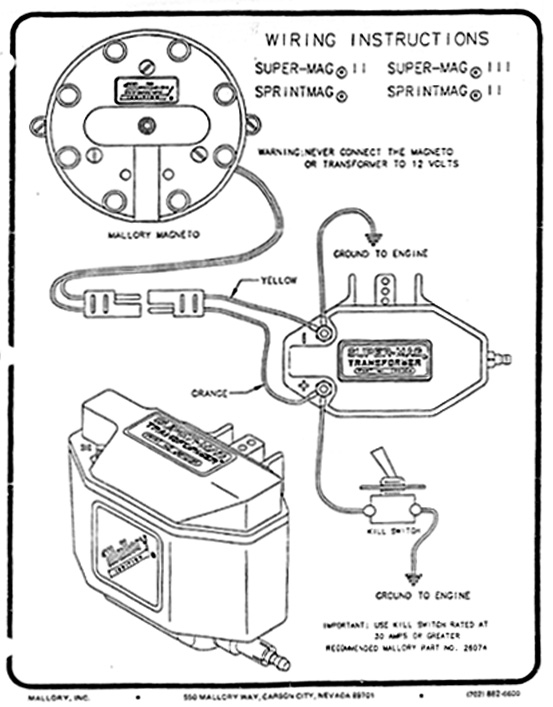
Click below for Magneto
Wiring Diagram:
Wiring
Instructions
Lucas Oil:
HEAVY DUTY OIL STABILIZER
Q: How do I use Lucas Oil Stabilizer in my vehicle?
A: It is recommended that you add the Oil Stabilizer with every oil
change (20% Stabilizer, 80% Oil). You may also use the stabilizer to top
off between oil changes in order to help reduce oil consumption in an
older engine, or maintain peak performance in a new engine.
Q: How many miles do I need to have
on my vehicle before I can start using Lucas Oil Stabilizer?
A: You don't have to have a specific amount of wear before you start
using our Oil Stabilizer. We use it in brand new engines ourselves! Put
in a quart each time you change the oil in your car. You should be able
to go at least 50% longer between oil changes and your engine will last
much, much longer.
Q: Can I use Lucas Oil Stabilizer in
anything else in my vehicle besides my engine?
A: Yes,
In addition to being great for your engine, you can also mix it 25% /
75% in the transmission and 50% / 50% in the differential. Lucas Oil
Stabilizer blends with any petroleum-based or synthetic oil, and is
formulated for gasoline or diesel engines.
Q: Heavy Duty Oil Stabilizer seems
pretty thick, Can I use it in my small car that requires light weight
oil?
A: In newer and smaller vehicles that require
light weight oils such as 5W- 30, we recommend our Pure Synthetic Oil
Stabilizer. Pure Synthetic Stabilizer was developed specifically for
engines that run on lighter weight
Q: Will using Lucas Stabilizer
void the factory warranty on my new vehicle?
A: No, using Lucas Stabilizer will not void a new car warranty.
Stabilizer is a 100% petroleum product that will blend with both
synthetic and non- synthetic oils.
PURE SYNTHETIC OIL STABILIZER
Q: Will using
Lucas Stabilizer void the factory warranty on my new vehicle?
A: No,
using Lucas Stabilizer will not void a new car warranty. Stabilizer is a
100% petroleum product that will blend with both synthetic and non-
synthetic oils.
Q: Can I use Pure Synthetic Oil
Stabilizer in non-synthetic oil?
A: Yes, contrary to common
belief, you can mix synthetic and non-synthetic oil. A common reason for
doing so is if your vehicle requires a light weight oil like 5W-30. Pure
Synthetic Stabilizer was developed specifically for engines that run on
lighter weight engine oils and in newer vehicles.
Q: Can I use Lucas Oil Stabilizer in
anything else in my vehicle besides my engine?
A; Yes, In
addition to being great for your engine, you can also mix it 25% / 75%
in the transmission and 50% / 50% in the differential. Lucas Oil
Stabilizer blends with any petroleum-based or synthetic oil, and is
formulated for gasoline or diesel engines.
FUEL TREATMENT
Q: Is your "Upper Cylinder Lubricant with Injector
Cleaners" the same as "Lucas Fuel Treatment"?
A:
Yes, the Upper Cylinder Lubricant with Injector Cleaners is the offical
name for the product that most people refer to Lucas Fuel Treatment.
Q: Is this product made for gasoline
or diesel engines?
A: Lucas Fuel Treatment was
designed to clean and lubricate the fuel systems of both gasoline and
diesel engines.
Q: How often can I use Lucas Fuel
Treatment?
A: Since Lucas Fuel Treatment does not
contain any solvents it is perfectly safe to run with every fill up. In
fact, many of our users run our fuel treatment with every tank because
they see an improvment in fuel mileage. The savings can be so great that
in some cases the money you save in fuel pays for the product and then
some.
POWER STEERING STOP LEAK
Q: Will the Lucas Power Steering Stop Leak correct the
squealing and hard spots in my steering?
A: Yes, the
Lucas Power Steering Stop Leak will correct squealing and hard spots and
fix most seal leaks in a worn rack and pinion. You can also use the
Power Steering Stop Leak in new units to prevent wear.
Q: I noticed that your Power
Steering Stop Leak says "Guaranteed" on the bottle. What do you mean?
A: We believe so strongly in our Power Steering Stop Leak that we
guarantee it will stop your leaking power steering unit or your money
back!
Q: My leak is getting better, is it
safe to use more than one bottle of Power Steering Stop Leak?
A: Yes, in some cases two bottles may be required to stop a seal leak in
your power steering unit.
Q: My power steering unit is
cracked. Will Power Steering Stop Leak still work?
A: No, Lucas Power
Steering Stop Leak is effective on seal leaks. Leaks resulting in
physical damage to power steering units will require attention from your
certified mechanic.
TRANSMISSION
FIX
Q: How should I use Lucas Transmission Fix?
A: We recommend adding a bottle of Lucas
Transmission Fix each time you change your transmission fluid
(approximately every 30-40,000 miles), or adding a bottle to your
current fluid to fix a small leak.
Piston Rings:
Q: Does Total Seal rings
require special cylinder honing?
A:
No, Total Seal rings do not require special cylinder honing. However,
they like all piston rings do require the cylinders to be honed properly
to start with. One of the most common causes of ring sealing issues
today is improper cylinder honing.
Q: What advantages does
the gapless top ring offer over the gapless 2nd ring?
A: The
Total Seal gapless top ring is the natural evolution of the gapless
second. By moving the gapless ring to the #1 ring groove they
effectively seal with cylinder closer to the combustion chamber. This
not only increases the cylinder seal on the compression and power
strokes but also improves the ring seal in the intake stroke resulting
in better cylinder filling on a normally aspirated engine. The increased
amount of force generates by the combustion process in turn delivers a
greater amount of energy to the crankshaft. The choice is yours and
either ring offers superior cylinder sealing.
Q: Can I use
gapless top or second rings on my blown alcohol motor?
A:
Yes, we have used the gapless second rings on our blown motors for years
with great success. The rings provide an unmatched sealing of the
cylinder compared to conventional rings and keep the leakdown/blow-by of
the cylinder to a minimum over longer periods of time, thus providing
more power to the crankshaft with fewer teardowns.
Q: Can
I use a gapless top ring if my piston is gas ported?
A: Yes,
Gas porting aids in keeping any top ring seated in high RPM/ high
cylinder pressure applications.
Q: When file fitting the
gapless ring do I need to file the rail also?
A: Yes, the
ring and the rail need to be filed*. Follow the gapping chart supplied
with the ring set.
*The rail end gap can be larger than the primary
ring but not smaller.
Q: Which way does the gapless ring go
on the piston, rail side up or down?
A: The gapless ring is
always installed rail side down.
Q: What should I set my
end gaps to?
A: Please follow the gapping chart supplied with
the ring set. Different applications require different amounts of gap.
If for some reason the gapping chart is missing or you are just not sure
please click this link to view the gapping chart we have on our website.
http://goodvibesracing.com/Total_Seal_Tech.htm
Q: Can I break my engine in on synthetic oil?
A: Though we
have seen it done successfully on occasion we do not recommend it. We
have seen the best and most consistent results breaking the engine in on
light viscosity conventional oil. Synthetics can be used after
completing the break in process.
Q: What is Quickseat?
A: Quickseat is Total Seals patented dry film cylinder wall assembly
lube. It is quite unique in that it is a dry lube that helps to prevent
glazing of the rings from the over use of assembly oil. It also provides
outstanding lubrication during the critical initial startup period
helping to prevent ring scuffing and cylinder wall burnishing.
Pit Mats:
Q: What is a PitMat?
A: A PITMAT is an exclusive material that can
be used on a variety of surfaces including gravel, dirt, grass,
concrete, asphalt and recycled asphalt. Its primary purpose is to
provide a clean durable surface to park and maintain your vehicle while
at the track or at the shop, but can be used for many other
applications.
Q: How much does a PitMat Weigh?
A:
10' x 20' = 43 lbs
10' x 30' = 71 lbs
10' x 40' =
83 lbs
12' x 30' = 85 lbs
12' x 40' = 102 lbs
15' x 30' = 97
lbs
15' x 40' = 127 lbs
Q: What color are Pit Mats
available in?
A: Black, Grey, Red, and Blue.
Q:
How do I clean a PitMat?
A: Purchase the PITMATUSA Pitmat
Cleaner, which was developed by a chemist for cleaning your PITMAT. Sold
by the gallon. Pitmat Cleaner is a concentrated product, and should be
diluted, although, depending upon your PITMAT'S condition, the
water-to-product mixture will vary.
Q: Will the Mat Hold up
to Floor Jacks and / or Pro Jacks?
A: Yes, as long as proper
care was taken to remove rocks and debris before setting up your PITMAT.
If using on asphalt it is recommended to sweep the area first before
setting up. If you are on soft grass it's recommend to put some wood
down to help support your jacks.
|